Corporate Governance Report (Japanese version only)
Fundamental Approach
We believe that strengthening corporate governance is the basis for a trusting relationship with stakeholders. In addition to raising the awareness of our employees through our corporate philosophy, based on our mission and responsibilities to wider society, we are also working to ensure transparency and soundness of management and speed up our decision-making process, such as through the improvement of auditing functions, and to actively disclose information in an appropriate manner.
Efforts toward Corporate Value Enhancement
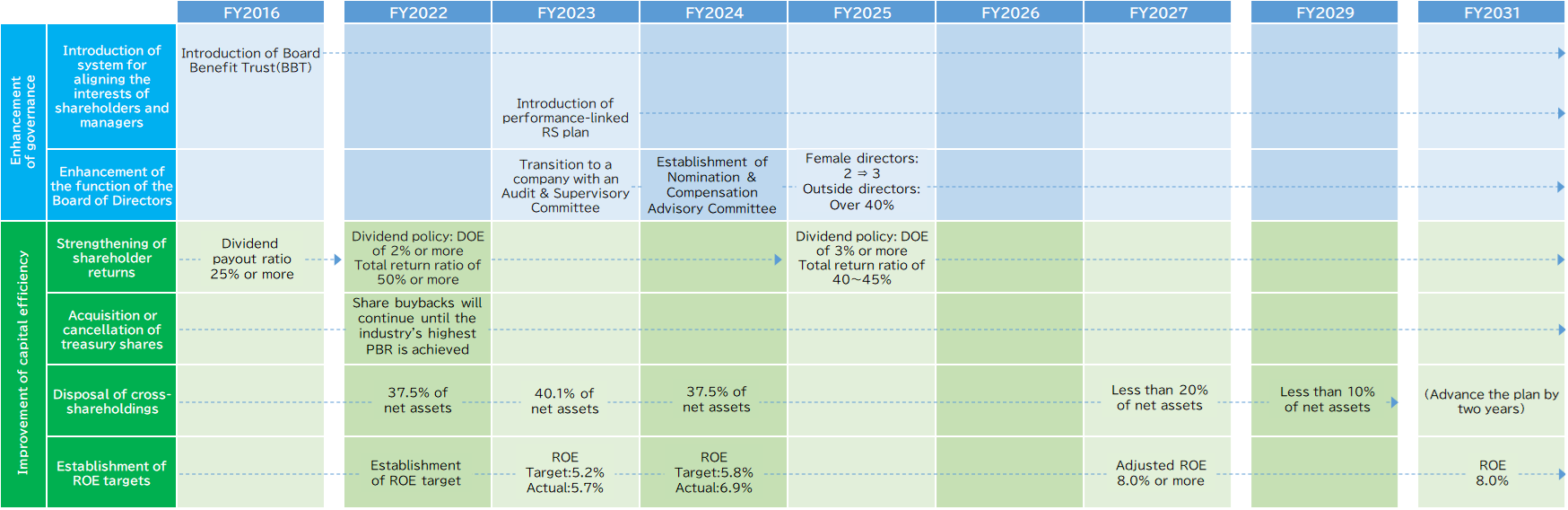 Click to enlarge
Corporate Governance Structure
With the approval at the 14th Ordinary General Meeting of Shareholders held on June 29, 2023, VITAL KSK Holdings transitioned to a Company with Audit & Supervisory Committee model.
The Board of Directors consists of 12 members, 3 of whom are women. In addition, 5 are outside directors with extensive experience and knowledge and deep insights into corporate governance from their perspectives as a business manager, academic experts, lawyers, and certified public accountants. By receiving highly meaningful recommendations and advice on the management of the Group, we ensure transparency and soundness of management, and have established a system to monitor and supervise the execution of duties by directors.
We have also established the voluntary Nomination & Compensation Committee to deliberate and advise the Board of Directors on matters such as the nomination and remuneration of directors, as well as overall corporate governance.
The Audit & Supervisory Committee consists of three members, two of whom are outside directors who perform accurate auditing and supervision functions from their respective professional standpoints and perspectives as a lawyer and certified public accountants. As of the July 2023 meeting of the Board of Directors, we have introduced a discussion time on various management issues to stimulate discussions at Board meetings. In the future we will incorporate external evaluations into our evaluations of the effectiveness of the Board of Directors, and we will continue working to enhance our corporate governance system.
Corporate Governance Chart
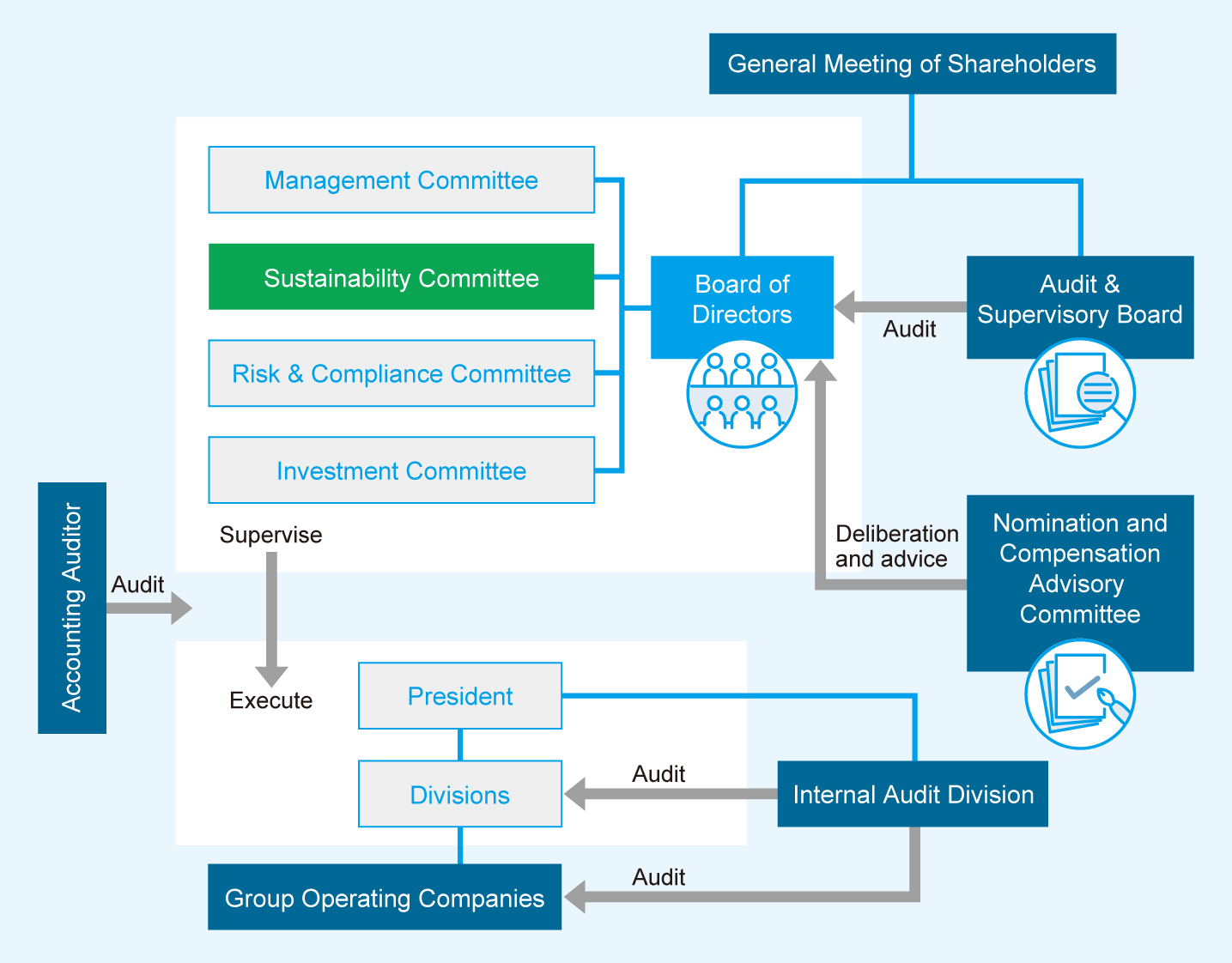
Board of Directors
The VITAL KSK Holdings Board of Directors is responsible for the Group’s executive management functions. It is composed of up to 12 directors as stipulated in the Articles of Incorporation (excluding directors who are Audit & Supervisory Committee members) and no more than five directors who are Audit & Supervisory Committee members. Membership is essentially determined to give the Company the effective management system required of a holding company, the appropriate number of members required to ensure substantive discussions at Board of Directors meetings, and the abilities, knowledge, and experience required for the actualization of the Group’s corporate philosophy and management strategy. As a general rule, meetings of the Board of Directors are held once a month, and separate meetings are held as necessary to decide upon matters dictated by laws and/or regulations and important matters relating to management, and to supervise the state of execution of business.
Key matters discussed in fiscal 2025
- Appointment of representative directors and directors with titles
- Determination of remuneration for directors
- Approval of conflicts of interest and competing transactions by directors
- Discussions and policy decisions to implement management with an awareness of cost of capital and stock price
- Business portfolio management
- Formulation of medium-term management plan
- Investment decisions for growth, such as new business and M&A
- Approval of financial statements
- Dividend Payments
- Convocation of General Meeting of Shareholders
- Report state of execution of duties
Nomination and Compensation Committee
In July 2024, we established the voluntary Nomination & Compensation Advisory Committee, as an independent advisory committee to replace the Advisory Meeting. Matters concerning the appointment of director candidates and compensation for directors are determined by consultation with the Committee (consisting of five outside directors and three representative voters) to obtain appropriate advice before resolution by the Board of Directors.
Key matters discussed at Nomination and Compensation Committee
- Policies and procedures for the appointment and dismissal of senior management and directors
- Performance assessment and personnel management for senior management
- Policies and procedures for the compensation of senior management
- Assessment and analysis of the effectiveness of the Board of Directors
- Policy on corporate governance structure including the Company’s institutional design
Attendance (FY2025)
Audit & Supervisory Committee
The Audit & Supervisory committee met mainly to verify quarterly and yearly financial results, receive reports from the Internal Audit Division on all aspects of the execution of business, and verify and evaluate that the execution of business throughout the Group was being conducted appropriately and efficiently, based on the annual audit plan. We ensure transparency and soundness of management through auditing and supervision by the appropriate operation of the Audit & Supervisory Committee.
To ensure thorough compliance with laws and regulations, the Group has also established a Compliance Statement, as a code of conduct for all officers and employees.
Key matters shared and discussed
- Audit policies, audit plans, and division of duties
- Evaluation of accounting auditor
- Review of Audit & Supervisory Committee audit standards
- Status of audits at each Group company
Overview of activities
| Director |
- Attendance at meetings of the Board of Directors
- Meetings with the representative director
|
| Execution of business |
- Viewing and checking important documents
|
| Internal audits |
- Audit plans and reports of findings from auditing divisions
- Meetings with internal control divisions
|
| Accounting audits |
- Three-party audit meetings
- Explanation of audit plans, quarterly review reports, and audit result reports from the accounting auditor
- Accounting auditor evaluations
|
Attendance at meetings of the Audit & Supervisory Committee (FY2025)
Evaluation of the effectiveness of the Board of Directors
To verify that the functions expected of the Board of Directors are being fulfilled appropriately and improve upon them, we conduct an annual evaluation of the Board’s effectiveness.
In addition to this, to verify the effectiveness of the system in a neutral and objective manner, we request an evaluation from a third-party assessment body at regular intervals (around once every three years).
The analysis and evaluation of the effectiveness of meetings of the Board of Directors held from April 2023 through March 2024 was conducted by a third-party assessment body.
A questionnaire-based survey of all directors was conducted regarding the state of execution and supervision, and the Board’s effectiveness was evaluated and analyzed based on the results.
Overview of evaluation
| Subject to evaluation
|
Meetings of the Board of Directors held from April 2023 through March 2024 (13 meetings) |
| Assessors
|
Directors (14 including Audit & Supervisory Committee members) |
| Evaluation method
|
Questionnaire-based survey by a third-party assessment body |
| Major evaluation items
|
General state of the Board of Directors, composition of the Board of Directors, operation of the Board of Directors, discussions at Board meetings, the monitoring function of the Board of Directors, the performance of internal directors (excluding Audit & Supervisory Committee members), the performance of outside directors (including Audit & Supervisory Committee members), and the support system and training for Directors (including Audit & Supervisory Committee members) |
The main issues identified in the results of this evaluation and measures taken to address them were as follows.
In addition, the following points were found to have improved in comparison with the time of the previous effectiveness evaluation conducted in April 2023.
- The introduction of a discussion time after the conclusion of deliberations and reporting Board meetings has deepened understanding of the industry environment, systems, and businesses to which the Company belongs, leading to more active discussions.
- The participation of highly specialized outside directors with expertise in various fields has led to the diversification of the Board’s membership, and stimulated more active discussions through the expression of diverse opinions.
- Discussions on indicators such as PBR, ROI, and ROE are also taking place. The contents of interviews with investors are also being shared, and there are opportunities for Board members to understand the thoughts and intentions of investors.